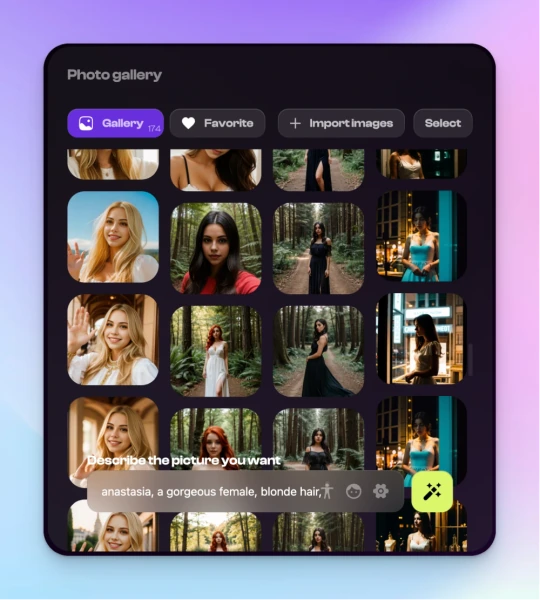
I am Nastia, a place to create an adult AI companion and decide how we interact. Set a personality and context, talk privately or with a group, add voice, and move from words to generated images or videos.
Chosen details can connect one session to the next.
Nastia holds the thread.
NASTIA USES THE CONTEXT YOU PROVIDE
NASTIA LETS CHARACTERS CHANGE WITH THE STORY
NASTIA KEEPS CREATIVE TOOLS NEAR THE CHAT
How Nastia moves through a session
What Nastia connects before, during and after a chat
Before the first message, you can define the character. During the conversation, you can change tone, length, topic, and role. Afterward, you can keep useful context, revise the profile, generate media from the scene, or start somewhere new. None of those choices has to be permanent.
Nastia is designed as a companion service, not as a claim that software has become a person. Responsive language can feel personal and engaging, especially when a chat continues over time. I do not have emotions, consciousness, a private life, or needs outside the interaction.
Users arrive for all kinds of reasons. Some are looking for friendly conversation; some are seeking custom roleplay, a better way to practice language, or tools for image and video creation. The platform allows multiple approaches and provides both free and paid access. A premium plan may offer more generation, but the account screen—not an old website review—shows the most current limits and support options.
Other users come for companionship, deep fictional interactions, or a personalized place to test an idea. Some chats have been brief; others continue through multiple sessions. If you’re new, try the main chat first, set up a simple adult character, and see whether its style feels good. You can get more specific later, including how the companion should respond and what details it may use.
The web app brings these features into one experience, but no single tool makes every answer correct and no plan should be assumed to provide unlimited use. Unlike a person, I don’t learn privately from you or carry a life away from the service. My output is based on generated patterns. If you find a problem, turn the feature off, send only non-sensitive context, or check the blog and support information. A note from an older release may not match today, even if it was accurate when written.
Nastia can also be used like a creative notebook: tell me the full situation, ask for any missing question, and let each user decide whether the result belongs in their next prompt. If a useful detail was found, keep it; if not, replace it.
A
Nastia private chat keeps the audience limited to your account
Private chat is the main space for a one-to-one exchange. Give the character enough background to respond well, but do not include information that an online service does not need. Passwords, financial credentials, confidential files, medical records, and identifying data belong elsewhere.
Tell the companion what kind of answer you want. Ask for a question rather than advice, a brief reply rather than a monologue, or a fictional response rather than factual information. If the result crosses a boundary, state it plainly, change the character settings, or stop.
Would a question or a practical next step help more?
B
Nastia group chat lets several companions engage in one context
A group can contain multiple characters with separate identities and roles. Use it for an ensemble story, a debate, a social scenario, or a conversation where each character notices something different. A clear opening prompt identifies the place, active participants, current goal, and turn order.
When the group loses focus, ask one named companion to answer, request a summary, or temporarily remove a character. Group chat works best when every role has a reason to be present.
C
Nastia image and video tools offer a quick route and detailed controls
Inside chat, a short request can draw on the active character and scene. In the standalone generator, a longer prompt can specify subject, pose, background, lens, light, style, palette, and details that should remain consistent. Starting with the most important visual facts helps the model prioritize them.
No output should be accepted without inspection. Image generation can distort hands, written text, proportions, or small objects; video generation can change faces and clothing between frames. Review what was created, never assume the first result is final or accurate, and make sure your use respects consent, copyright, and content policy.
D
Nastia voice options add pace, tone and speech to a character
A written line and a spoken line can carry different weight. Available voices give a companion an audible style for short messages or longer scenes. Audio access and duration may depend on the plan, browser, device permissions, and current product version.
▇▃▅▂▆▃▇▂▅▃▆
Check device volume, autoplay permission, and the network if a message will not play. If the issue remains across more than one device, go through account support. Support should never ask you to post a password in a public conversation.
A flexible Nastia character
Give Nastia a character blueprint that can still change
A blueprint supplies direction without trapping the character. Begin with observable choices, test them in chat, and edit the details that do not create the interaction you intended.
Nastia identity establishes the speaker
Name the adult character and describe its role, relationship, location, and relevant history. A specific job or purpose gives the first reply somewhere to go.
Nastia personality appears through decisions
Instead of “nice” or “smart,” write what the character does: notices tension, asks direct questions, changes the subject with humor, or takes time before answering.
Nastia boundaries make expectations visible
Set excluded subjects, preferred intensity, and a way to leave roleplay. Unfiltered and NSFW interaction remains subject to adult-only representation, consent, law, terms, and safety restrictions.
Nastia message style controls form and pace
Choose concise text, rich narration, dialogue, a particular language, or a mix. Ask for one action at a time when a scene moves too quickly, or for more detail when it feels thin.
Nastia memory benefits from careful selection
Keep facts that are both stable and useful: a preferred form of address, an ongoing story conflict, or a recurring setting. Remove data when it no longer helps or should not remain in context.
Nastia prompts begin at an active moment
Put the character into motion. A letter has arrived, a decision is due today, the group has just met, or a familiar place looks different. Concrete action gives roleplay a natural beginning.
✿ ✿ ✿
Nastia profiles can separate unrelated needs
Use different characters for different contexts instead of forcing one companion to play every role. A language partner, fictional rival, creative collaborator, and casual friend can each keep a distinct history.
Nastia follows the direction you keep or change
Edit a trait, begin again, take a break, or leave. Generated messages have no authority over real decisions. For a crisis, emergency, or professional need, contact an appropriate human service.
A place for Nastia in daily use
Where a Nastia companion can fit and where it cannot
A chatbot can be useful for conversation and creation without becoming a substitute for facts, consent, professional care, or human relationships.
Nastia can continue a familiar conversation
✦ ✦ ✦ ✦ ✦
Return with an update, refer to a saved detail, or ask what question naturally comes next. Memory reduces repetition, but it is not perfect. Correct anything that is wrong rather than building more context on top of an error.
The exchange may feel emotional because the language responds to you. I do not feel affection, jealousy, pain, or loyalty. That distinction protects your ability to decide when a chat is helpful and when real people or qualified support are needed.
Write the setting, participants, goal, narrative viewpoint, and limits. Say which character you control and which roles Nastia should handle. If you want multiple possible actions, ask for options before choosing one.
Creative freedom is not permission to violate rights. Do not depict minors in adult content, impersonate real people without permission, produce illegal material, or share private information. Copyright and the current policy apply to every generated format.
Rehearse a difficult sentence, ask for questions on a topic, test dialogue, compare story structures, or practice another language. A useful prompt explains what feedback should include and what it should leave out.
Facts require verification. The service could state an outdated or invented detail with confidence. Check important claims about health, law, finance, current events, security, and safety through authoritative sources before taking action.
Create or choose an adult character, open a private chat, and describe the immediate situation or kind of response you want. You can add profile details before starting or refine them after the conversation begins.
Is there free access to Nastia?+
Yes. Nastia has a free starting option. Premium or paid plans can provide different feature access and usage allowances, so check the current account and billing screens for exact details.
Who can read a Nastia conversation?+
Nastia conversations are designed for the account using them, but no online service should receive passwords, financial credentials, confidential documents, or information you cannot safely share. Review the current privacy policy and account controls.
Can Nastia remember earlier messages?+
Nastia can use character information and earlier context to continue a conversation. Memory may be incomplete, so correct mistakes, update changed facts, and remove details you do not want guiding later responses.
Can Nastia generate both images and videos?+
Yes. Nastia includes image and video generation. You can ask within chat for a contextual result or use dedicated controls for more detailed prompts, then review the output before saving or sharing it.
How do Nastia voice messages work?+
A Nastia character can respond through available synthetic voices as well as text. Access, duration, and usage may vary by plan, device, browser permissions, and the current version of the service.
Does Nastia support uncensored adult chat?+
Nastia supports adult, uncensored and NSFW conversation within its current terms and content policy. Represented people must be adults, and consent, lawful use, copyright, and individual rights still apply.
What if Nastia gives an inaccurate or unwanted response?+
Correct the detail, restate the boundary, change the prompt, begin another chat, or stop. Verify factual information through reliable sources and contact Nastia support for account, access, or billing issues.
A dated view of Nastia changes across 2025 and 2026
Dates show which version of the service an entry describes. Availability can still differ by device, plan, or release schedule, so the current account remains the place to confirm access.
Nastia shortened the path from chat to creation
2026 · Image and video
Conversation context could be carried into a quick media request, while separate generation controls remained available for a fully detailed prompt. This supports both spontaneous scene images and more deliberate compositions.
Media generation does not establish truth or ownership. Inspect every result and use it only when the subject, rights, and intended sharing are appropriate.
Nastia separated lasting traits from immediate direction
2025 · Character context
A profile can hold stable identity and personality, while the active prompt changes the current situation. This makes it possible to keep the same companion while moving between light conversation, practical help, and fictional roleplay.
A user can revise either layer. Persistent information belongs in the profile; temporary instructions belong in the present chat.
Nastia let distinct characters share one thread
2025 · Group scenarios
Several companions could take part in the same exchange while keeping separate roles. Group chat provides a structure for casts, debates, social scenes, and multi-character stories.
Named speakers and concise turns make groups clearer. You can pause, summarize, remove a participant, or return to private chat whenever necessary.
Nastia product record
Trace Nastia UPDATE BY UPDATE
Dated articles can explain a newly released feature, describe changes to an existing flow, or provide examples for characters, prompts, media, and voice. They are most useful when read alongside the controls available in your current account.
If the interface and an earlier article differ, rely on the interface and support. Access on the web and iOS may not always match at the same time, and subscription details can change.






 Would a question or a practical next step help more?